



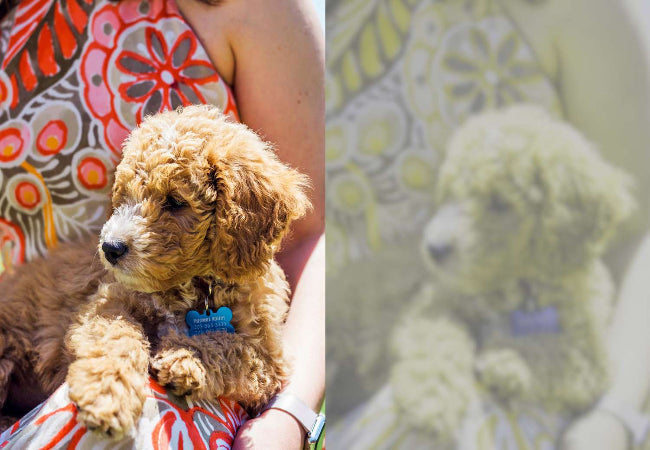


Dogs perceive the world differently from humans. Their eyes and visual systems have evolved to meet their unique needs as predators and companions, rather than for detailed color perception or fine visual acuity like ours. Understanding how dogs see can help you interpret their behavior and provide a better environment for them.
🌈 Color Perception
Unlike humans, dogs have two types of color receptors (cones), compared to three in humans. This limits their color perception:
-
Dogs primarily see shades of blue and yellow.
-
They have difficulty distinguishing between red and green, which may appear as shades of gray or brown to them.
This doesn’t mean dogs live in a dull world—they rely on motion, contrast, and brightness far more than color to interpret their surroundings.
👁️ Visual Acuity
Dogs generally have lower visual acuity than humans:
-
Average visual acuity for dogs is around 20/75, meaning what a human sees clearly at 75 feet, a dog can see clearly at 20 feet.
-
While they may not see fine details as sharply as we do, dogs are excellent at detecting movement, even at a distance.
🔭 Field of View
Dogs often have a wider field of view than humans, which is essential for spotting predators or prey:
-
Depending on breed and eye placement, their field of view ranges from 240° to 270°, compared to the human average of 180°.
-
This panoramic vision allows them to notice movement in their periphery and better understand their environment.
🌙 Night Vision
Dogs are naturally equipped for low-light conditions:
-
They have more rod cells than humans, which detect light and motion rather than color.
-
A reflective layer behind the retina called the tapetum lucidum amplifies available light, enhancing night vision.
-
This adaptation helps dogs navigate and detect movement in dim environments, making them excellent hunters at dawn or dusk.
🏃 Motion Detection
One of the strongest aspects of canine vision is motion detection:
-
Dogs are highly sensitive to moving objects, even at a distance.
-
This skill helps them track prey or respond to environmental changes quickly.
-
Sudden movements are much easier for dogs to detect than static objects, which is why dogs may notice wildlife or moving toys faster than humans do.
🐾 Key Takeaways
-
Dogs rely more on motion, contrast, and brightness than on color or fine detail.
-
Vision varies between breeds, individual dogs, and age, so some dogs may see better or worse than others.
-
Changes in your dog’s vision, like bumping into furniture, reluctance to navigate stairs, or failing to respond to visual cues, may indicate a vision problem. Consult your veterinarian if you notice these signs.
Understanding your dog’s visual strengths and limitations can help you enhance their environment, choose toys wisely, and ensure their safety, particularly in low-light conditions.
Do you want me to do that next?
Recommended by Dr Duncan
Vet-designed gear for what you have just read about.
- Schnüffelball mit KnistereffektShop
Hide treats & keep dogs engaged through sniff, search & crackle sounds
- Chewster Schildkröten-SpielzeugShop
For power chewers. Slow-release treat play for focused sniff & chew sessions
- Chewster Blocky KnochenShop
For power chewers. Roll, chase & earn treats through chew play