



Ask ten people at the dog park which harness is best and you'll get eleven answers, most of them a brand name. Here's the honest bit: the research on dog harnesses is a lot less tidy than the marketing, and no single harness suits every dog.
That's actually good news, because it means the right harness for your dog comes down to things you can check at home: your dog's shape, how hard they pull and how well the thing fits. This guide covers what vet Dr Duncan Houston looks for in a harness, what to be wary of, and how to match a harness to body types from Chihuahuas to greyhounds.
Quick answer
There's no one harness every vet recommends for every dog. Choose one that keeps pressure off the throat, adjusts at the neck and chest, fits with about two fingers under each strap and lets your dog take full strides. Use a front clip for pullers and a back clip for dogs that already walk nicely.
Why a harness instead of a collar for walks?
A collar's main job is carrying your dog's ID. For walking, especially with a dog that leans into the lead, animal welfare and training organizations generally recommend a harness, because it keeps the pull off the neck.
Dr Duncan's advice: Harnesses should cause less pain than collars. Collars can cause coughing and choking, can make a collapsing trachea worse, and a hard jerk on the neck can cause a breathing emergency. From my clinical experience, we definitely see dogs that pull on collars having respiratory distress.
The research is clearest for some dogs in particular. In one study, pulling against a collar raised the pressure inside dogs' eyes while pulling against a harness didn't, and the authors advised that dogs with glaucoma, thin or weak corneas, or other conditions where higher eye pressure could be harmful should wear a harness instead of a collar. Flat-faced breeds are the other big group, and they get their own section below.
What to look for in a harness
Start with the harness itself.
Dr Duncan's advice: In a harness, I look for:
- a padded inner
- round edges
- a handle on top
- an ID tag ring that's separate from the D-ring the lead attaches to, in a spot where it's easy to see
- a padded handle
- reflective edges and webbing
- adjustable at the front and back
- double stitching
- a front D-ring to stop leash pulling
- a top back D-ring for normal walking
- thick, strong D-rings for leash attachment
Then check how it fits your dog:
- A clear throat. The front of the harness should sit low on the chest, over the breastbone, not across the windpipe.
- The two-finger fit. You should be able to slide about two fingers flat under every strap. Too tight pinches; too loose slides around, can chafe and makes it easier for your dog to back out.
- Room for the shoulders. Watch your dog walk with the harness on and off. If their stride changes, adjust it or try another style.
- No escape route. If an elbow can slip through a strap, the harness is too loose.
It's also worth asking your own vet to look at the fit at your next visit.
Y-front or straight across?
Dr Duncan's advice: I would avoid styles that have a large strap across the chest, as these can restrict shoulder movement outwards as well as forwards and backwards.
Some welfare groups give the same advice and suggest avoiding harnesses that cross directly in front of the shoulders. The studies so far are mixed. In one small study, both styles reduced how far dogs extended their shoulders, and the Y-shaped "non-restrictive" harness reduced it slightly more, while a recent review of the studies concluded that every harness changes a dog's gait a little and that chest-strap and Y-shaped designs are likely to be the least restrictive.
The same review found that no restraint device can be recommended for every dog.
Whichever style you choose, fit it to the dog in front of you. Researchers found that where the straps land relative to the elbows and shoulder blades, which depends on your dog's build, matters a lot, so do the walk test at home as well.
Matching a harness to your dog's shape
Small and toy breeds (Chihuahuas, Maltese, Pomeranians, Yorkies)
Little necks deserve a break from lead pressure. Neck collars have been linked with airway problems such as tracheal collapse, which is common in small breeds like Chihuahuas and pugs, and thick leads with big clips are often too heavy for small dogs and can put undue pressure on the neck and spine. So keep the lead on a harness and the hardware light.
Check the sizing carefully. Our Explorer Harness starts at a 43 cm (17 in) chest (Small, for dogs of about 5 to 15 kg, or 11 to 33 lb), so very small dogs may need a harness smaller than that.
Flat-faced breeds (French bulldogs, pugs, Boston terriers, shih tzus)
Harness, every walk. Pressure on the neck can make breathing problems worse in flat-faced dogs, so clip the lead to a well-fitted harness instead of a collar. Researchers have also found that simply wearing a collar while standing still raised eye pressure in flat-faced dogs, and a review of the research concluded that flat collars should not be used on them.
Barrel chests and short necks make fitting fiddly. Check that the neck loop sits low and doesn't ride up toward the throat when your dog sits or turns, and that the chest strap clears the armpits.
Deep chests and narrow heads (greyhounds, whippets and other sighthounds)
Many of these dogs have heads no wider than their necks, so collars slip off easily and a harness matters even more. Measure the chest at its deepest point, just behind the front legs, and fit the neck loop carefully so a backward wriggle can't pull it over the head.
Long backs and short legs (dachshunds, corgis, bassets)
In one study of different breeds, the distance from the floor to the elbow was a key factor in whether a harness restricted a dog's stride. For low-slung dogs, check that the chest strap doesn't sit right in the elbow crease and that nothing slides back toward the belly.
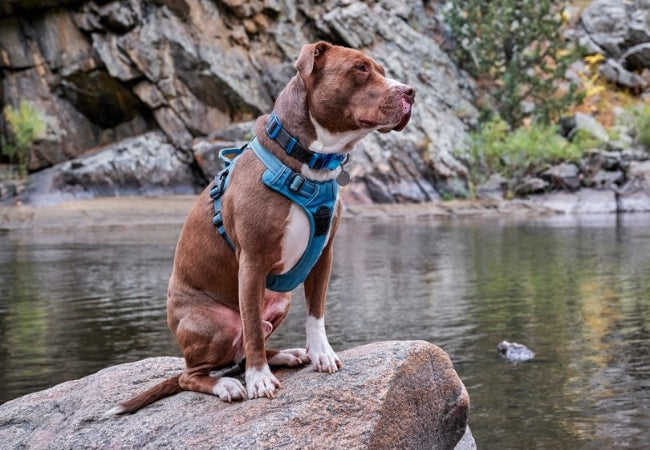
Big, strong pullers (labradors, staffies, huskies, shepherds)
This is where the front ring earns its keep. On our Explorer Harness, clipping the lead to the chest plate means a surge turns your dog sideways, back towards you. As its product page puts it: "The front clip changes the physics of pulling; training changes the habit."
Two research findings are worth knowing. In studies, dogs pulled more in back-clip harnesses than in collars, probably because leaning into the chest is less uncomfortable than leaning into the neck. Front-clip harnesses, on the other hand, reduced pulling. So a back-clip harness on a strong puller can make walks harder, not easier.
Dr Duncan's advice: For a dog that pulls, a harness. A collar puts all the pressure on the trachea, vessels and nerves, which can cause issues. I have seen spinal problems and breathing problems, especially in dogs on collars, from acute injuries as well as chronic ones.
Growing puppies
Puppies change shape almost weekly. Buy adjustable, expect to size up, and check the fit of a puppy's harness at least a few times a week.
How to measure your dog for a harness
- Chest: wrap a soft tape around the widest part of the ribcage, just behind the front legs.
- Neck: measure low on the neck, where a collar sits.
- Weight is a guide only. Go by the chest and neck measurements.
- Between sizes? Go up a size and adjust it down.
- Fit check: two fingers flat under every strap, the front of the harness on the breastbone, then the walk test and the elbow check.
Common mistakes
- Buying by breed or weight alone. Two dogs of the same breed can need different sizes.
- Expecting a front clip to fix pulling on its own. It changes the mechanics; lead training changes the habit.
- Hanging the ID tag or a light on the lead ring. A lead clip can snap them. Use the separate tag ring.
- Counting on padding to make up for a poor fit. Researchers note that padding and strap width may create uneven pressure, so fit still comes first.
- Leaving the harness on all day. It's walking gear. See can a dog wear a harness all day?
- Tightening it to stop an escape artist. Refit it or try a different style instead.
Where WOOPF™ harnesses fit in
Here's what each WOOPF™ harness page lists.
- Explorer Harness: front and back D-rings, a padded top handle that's neoprene-lined and double stitched, four adjustment points at the neck and chest, elastic chest loops that give as your dog breathes, 3M reflective trim, a separate ID tag ring and a loop for a clip-on light. Small fits a 43 to 56 cm (17 to 22 in) chest, Medium 53 to 68 cm (21 to 27 in) and Large 65 to 82 cm (26 to 32 in).
- Sealskin Harness: coated webbing that rinses clean and dries quickly, front and back D-rings, neck and chest adjustment and a built-in tag ring, for beach trips and muddy walks. It's made for dogs that get really wet, so it has no padding, and the top strap works as the handle, so there's no extra one on top. Heavy pullers still learning, or dogs prone to rubbing, may be better suited to the padded Explorer.
Neither replaces lead training, and both need the same fit checks as any other harness.
Frequently asked questions
Do vets recommend harnesses or collars?
For walking, a harness is the usual advice, because it keeps the load off the neck. A collar still earns its keep as the home for your dog's ID tag.
Are no-pull harnesses bad for dogs?
Not the right kind. Any no-pull gear works by making pulling a little less comfortable, so choose a front-clip harness that doesn't tighten, fit it well and pair it with reward-based lead training. Skip harnesses that tighten around the chest or belly when your dog pulls.
What harness is best for a French bulldog?
One that keeps the lead well away from the throat, adjusts at both the neck and chest to suit a wide chest and short neck, and passes the walk test. The flat-faced section above has the details.
What does "vet recommended" on a harness actually mean?
Treat it as a starting point, not a guarantee. Ask who recommended it, for what kind of dog, and what they checked. A harness can suit one dog beautifully and rub the next, so the checklist and fit checks above beat any label.
How tight should a dog harness be?
Snug enough that it doesn't twist or slide, loose enough to fit about two fingers flat under every strap. Recheck it after a swim and whenever your dog's shape changes.
Keep going
Still deciding between gear types? Read our take on dog harness vs collar, and if pulling is the main problem, see our guide to harnesses for dogs that pull.
For the medical side, ASK A VET™ goes deeper in How to Choose a Dog Harness That Fits Their Shape and Tracheal Collapse in Dogs: Honking Cough, Treatment and Emergencies.
More dog health reading lives at ASK A VET™.
Recommended by Dr Duncan
Vet-designed gear for what you have just read about.
- Explorer HarnessShop
No-pull training harness with adjustable fit
- Poop & Go 100% Compostable BagsShop
100% compostable & plant-based
- Explorer Bungee LeashShop
Run together. Designed for pullers & high-energy dogs