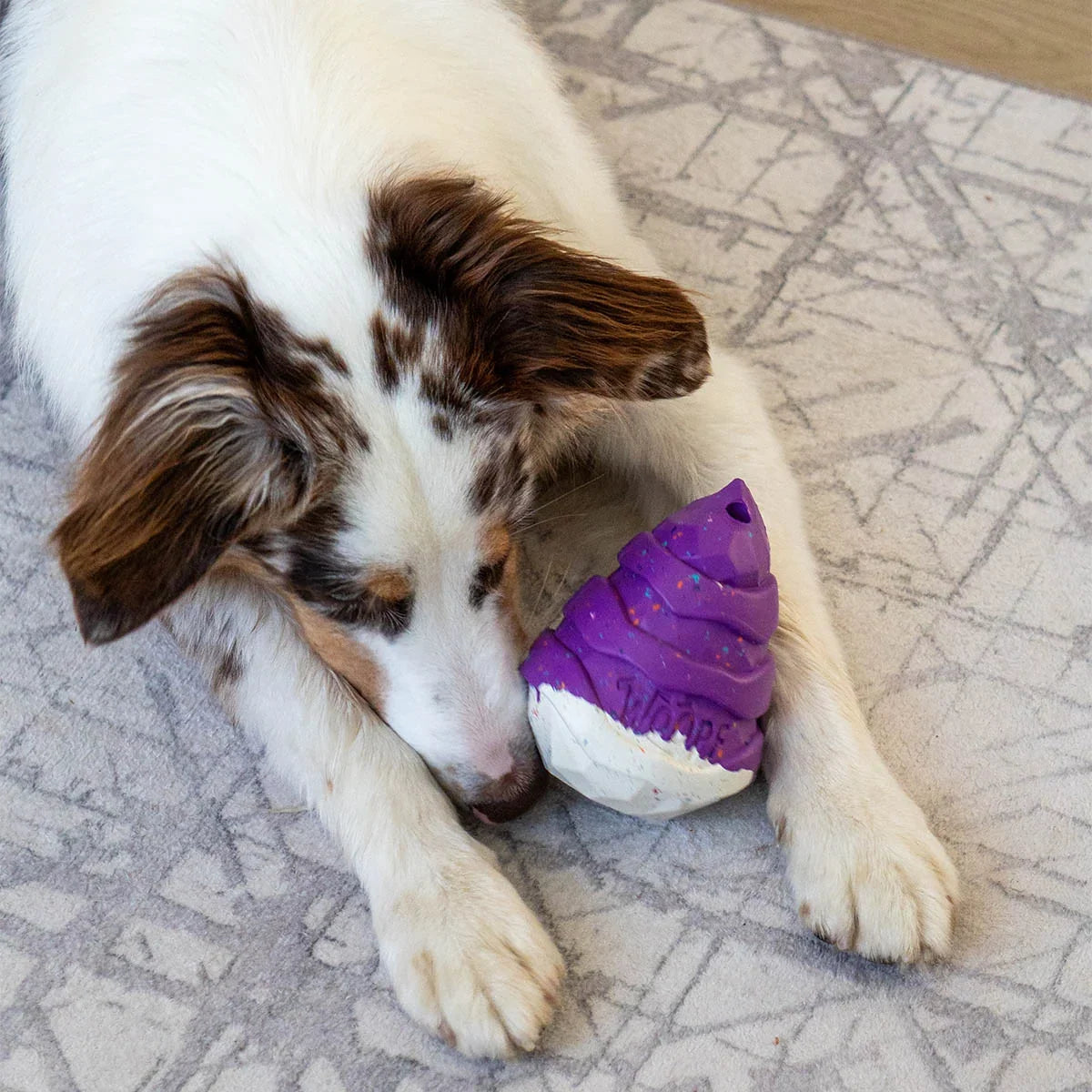


A treat-dispensing toy is only as good as what goes inside it. Fill it with a few loose biscuits and it's empty in seconds. Pack it like concrete on day one and your dog gives up and goes back to chewing the couch.
The trick is somewhere in between, and it changes as your dog gets better at the game. Here's what to put in a treat toy, what to keep out of it, how to freeze it, and how to make one filling last a lot longer.
Quick answer
Start with your dog's own kibble so the food falls out easily. Once they've got the hang of it, add a soft layer of wet food, plain yogurt or mashed pumpkin, pack it tighter, or freeze it. Count it as part of the day's food, and never use anything containing xylitol.
How treat-dispensing toys work
A treat-dispensing toy is a hollow rubber toy with a hole or two. Food goes in, and your dog has to roll, nudge, chew and lick to get it back out. Dog welfare charities describe stuffed rubber toys as a way to keep a dog busy and mentally stimulated, and puzzle feeders as a way to slow fast eaters down while they use their brain and nose.
The filling decides how hard the job is. Blue Cross puts it simply: it shouldn't be too easy or too hard for your dog to get to their food, as this can cause frustration, so build up slowly as your dog gains experience.
Think of it as a ladder. Each step is a little harder than the last, and your dog only moves up once they've cracked the one before.
The easy-to-hard ladder
San Diego Humane Society teaches a five-level version of this ladder. Here it is in our words:
- Dry food only. Fill the toy with your dog's usual kibble. It tumbles out as soon as they nudge it, so they learn that the toy means food.
- Add a soft top. Fill most of the toy with kibble, then finish the opening with a spoonful of wet food, plain yogurt or mashed pumpkin.
- Freeze just the top. Pop a step-2 toy in the freezer until the top layer sets.
- Mix it through. Stir the soft food into the kibble and pack the whole toy with the mix.
- Freeze it all. Freeze a step-4 toy solid. San Diego Humane says this version may keep a dog busy for up to 45 minutes.
The levels are there to keep frustration down. If you jump straight to a frozen toy, your dog may give up and lose interest. If your dog walks away, go back a step and make the next few sessions easy wins.
What to put in a treat toy
The easiest filling is the food your dog already eats. Their usual kibble works on its own, and their usual wet food makes a good binder that holds kibble in place. Both mean nothing new for their stomach.
For variety, the fillings our own Chewster pages list are kibble, wet food, plain yogurt, mashed pumpkin and xylitol-free peanut butter. Dogs Trust's list of human foods you can usually feed a dog in moderation includes bananas, carrots, cheese, Greek yogurt and peanut butter that's free of xylitol and additives, so small pieces of those work too.
A few rules make any filling better:
- Count it as food. Whatever goes in the toy is part of the day's food. Blue Cross reminds owners to feed a little less at dinner on stuffed-toy days, and our Blocky Bone page says the same.
- Keep rich extras small. Peanut butter and cheese are high in fat, so use them as a smear at the opening rather than the whole filling.
- Introduce new foods slowly. Try a little of anything new before you pack a whole toy with it.
- Special diets. If your dog is on a prescription diet, has food allergies or a sensitive stomach, fill the toy with their usual food and check with your vet before adding anything new.
So what's the go-to filling for vet Dr Duncan Houston?
Dr Duncan's advice: Freeze-dried meat products and peanut butter.
What to keep out of it
Read the label on anything that didn't come out of a dog food bag.
- Xylitol. Xylitol, also sold as birch sugar or wood sugar and sometimes listed as E967, turns up in some peanut butters and other sugar-free products, and even a small amount can be fatal to a dog.
- Other toxic foods. Keep the other usual suspects out of the toy too, including chocolate, grapes and raisins, and anything with onion or garlic.
If your dog eats something containing xylitol, or any other poison, go straight to an emergency vet. Don't wait for signs, and don't try to make them vomit at home. Take the packaging with you if you can.
Is there a filling Dr Duncan would never put in one?
Dr Duncan's advice: Toxic things, like sugar-free products with xylitol. Make sure you watch what you put in, and clean the toys regularly.
Freezing a treat toy
Freezing is the easiest way to make one filling last longer. Blue Cross says freezing can hugely increase the time it takes a dog to work the food out, and a frozen toy is a cool job on a hot day.
- Fill and pack. Layer kibble and a soft binder such as wet food, plain yogurt or mashed pumpkin, pressing it down as you go.
- Keep the air hole clear. If your toy has a small second hole, leave it open. On our Snacky Hive, that hole is there so the toy can't create suction on a tongue.
- Stop the spills. Wrap the toy in plastic wrap so the filling sets without leaking in the freezer.
- Freeze, then serve. Freeze it until the filling has set. For a beginner, freeze just the top layer first, as on step 3 of the ladder.
Batch-freezing two or three toys at once means there's always one ready to go. So when does Dr Duncan freeze a filled toy?
Dr Duncan's advice: I freeze it if I have time, and dogs love it, but you need to assess your dog's behavior before doing this, and make sure the toy is the right size for their mouth.
Choosing the right size and strength
Fillings only work in a toy that suits your dog.
- Size. Blue Cross says to find the right size toy for your dog to prevent choking, and our Blocky Bone page puts it plainly: choose a toy your dog can't fit completely inside their mouth, and size up if they're between sizes.
- Strength. Rubber toys come in different chew strengths. Match the rubber to your dog's jaw, from soft for gentle chewers to hard for power chewers.
- Supervise and check. No chew toy is indestructible. Stay nearby, look the toy over after each session, and retire it once a piece can be bitten off or a hole starts to widen.
- Swallowed pieces. If your dog has bitten off and swallowed a piece of the toy, or anything else that isn't food, call your vet straight away rather than waiting to see what happens.
- One dog, one toy. In a multi-dog home, or with a dog that guards food, hand out stuffed toys in separate rooms or behind a baby gate.
Keeping it clean
Old filling goes off quickly inside a hollow toy. Wash it after every use, on the top rack of the dishwasher or with warm soapy water and a bottle brush through the holes, and let it dry before you refill it.
Common mistakes
- Starting too hard. A frozen, tightly packed toy on day one teaches a dog that the toy is boring.
- Forgetting the calories. Stuffed-toy food is still food. Take it out of their meals.
- Grabbing the wrong peanut butter. Check every jar for xylitol, every time.
- The wrong size. A toy that fits right inside the mouth is a choking risk.
- Leaving a strong chewer alone with it. That's how pieces come off and get swallowed.
- Skipping the wash. Leftover food in the hole gets grubby fast.
The WOOPF™ Chewster treat toys
Here's what each WOOPF™ Chewster page lists.
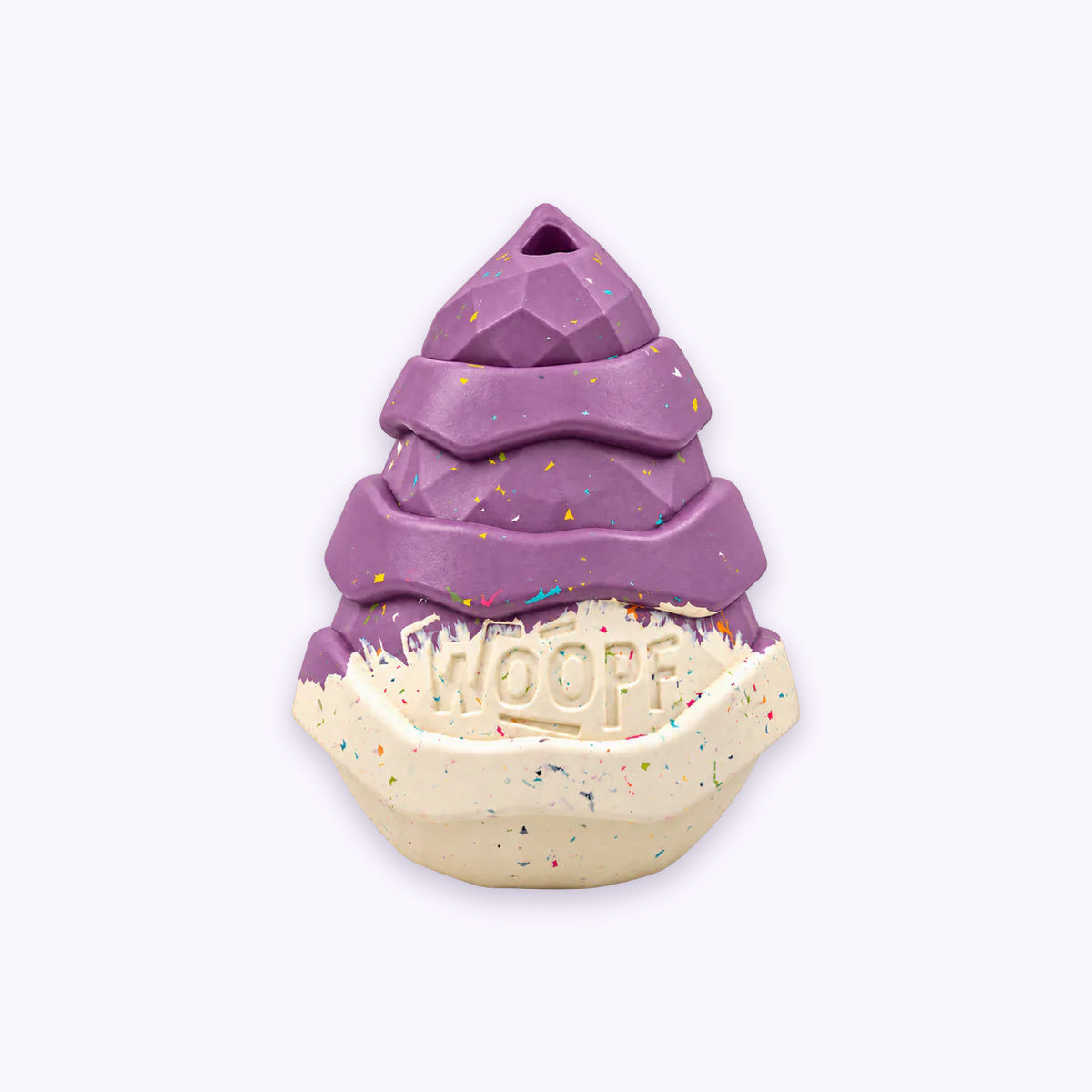
- Chewster Snacky Hive: a hollow hive that holds roughly a cup (about 240 mL) of kibble, filled through a 25 mm (1 in) hole in the base. A 10 mm (0.4 in) hole in the top vents the body so it can't create suction on a tongue. It measures 12 × 10.5 × 10.5 cm (5 × 4 × 4 in), comes in four chew strengths, and the page suggests packing it with wet food, plain yogurt or mashed pumpkin and freezing it for a longer session.
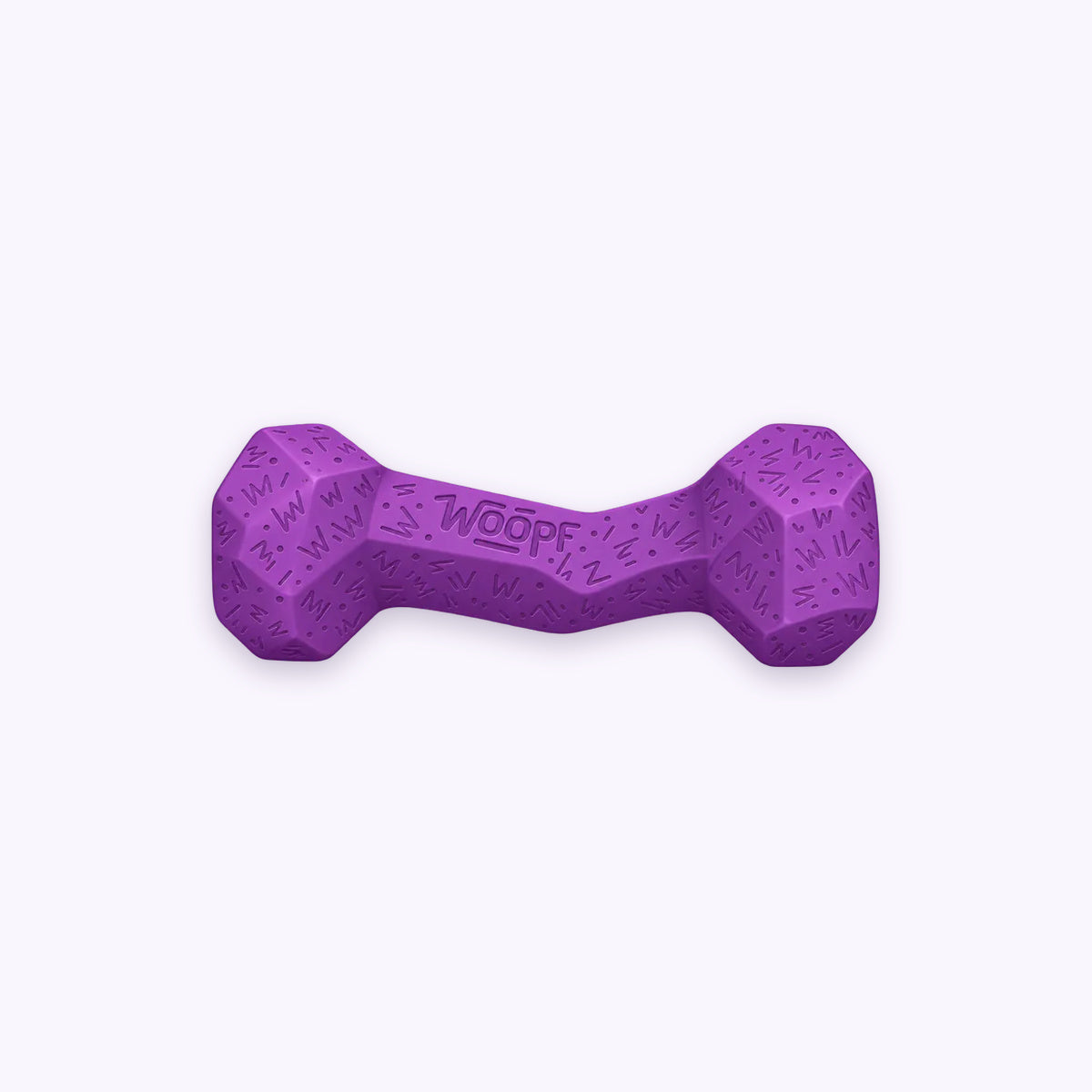
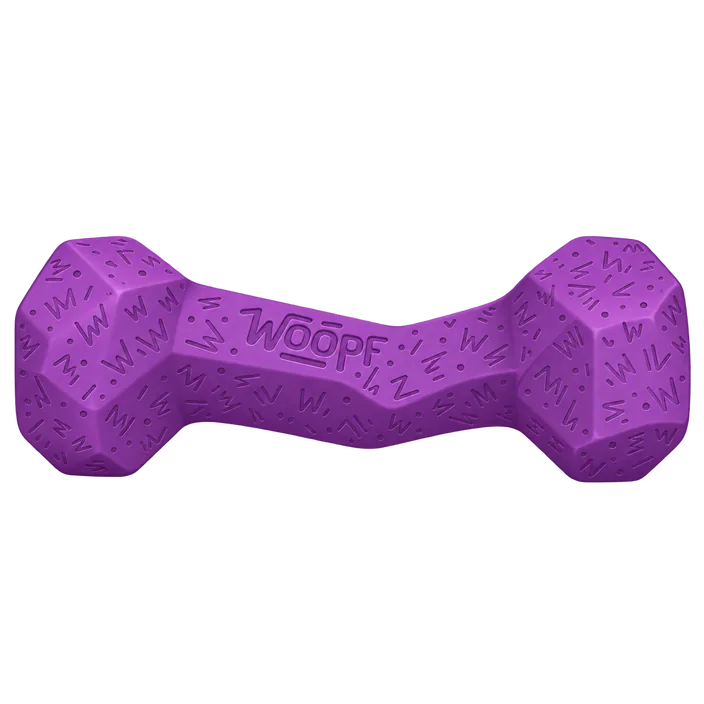
- Chewster Blocky Bone: a rubber bone with a treat hole at each end, for kibble, wet food or xylitol-free peanut butter, and freezer safe. It comes in Small (up to 10 kg (22 lb)), Medium (10 to 25 kg (22 to 55 lb)) and Large (25 kg (55 lb) and up), and the page says it's suitable once adult teeth are through, rather than during teething.
- Chewster Turtleshell: a shell with a treat hole in the base that spins and slips as your dog works it, for dogs of about 5 to 35 kg (11 to 77 lb), in Soft, Standard or Hard.
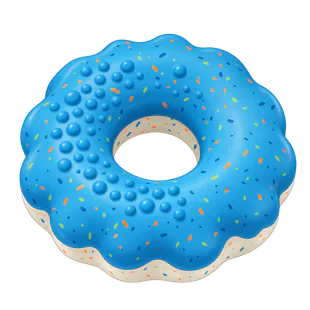
The same range also has the Chewster Donut and the Chewster Octopus. Each page is clear about the limits too: no chew toy is indestructible, so check the toy after every session and replace it once pieces come off.
Frequently asked questions
Can I put peanut butter in a treat-dispensing toy?
Yes, as long as the label shows no xylitol, also called birch sugar. Use a smear at the opening rather than a whole toy's worth, and count it as part of the day's food.
How do I make a treat toy last longer?
Move one step up the ladder: add a soft layer, mix it through, pack it tighter or freeze it. Only make it harder once your dog finishes the easier version without giving up.
Can puppies use treat-dispensing toys?
Yes, with a toy made for their size and stage and with you nearby. Use their own puppy food, keep it easy, and check the toy's page for its age advice. Our Blocky Bone page, for example, says it's suitable once adult teeth are through.
How do I clean a treat-dispensing toy?
Rinse out the old filling, then wash the toy on the top rack of the dishwasher or with warm soapy water and a bottle brush. Let it dry before refilling.
Keep going
If your dog loves a slow, calm job, a lick mat is the flat cousin of the treat toy: read are lick mats good for dogs? for how to use one well.
For which peanut butters are safe and how much to use, ASK A VET™ has can dogs eat peanut butter?, and for what to do if a dog gets into something sugar-free, xylitol poisoning in dogs.
Not sure which filling suits your dog? More dog health help lives at ASK A VET™.
Recommended by Dr Duncan
Vet-designed gear for what you have just read about.
- Chewster Blocky BoneShop
For power chewers. Roll, chase & earn treats through chew play
- Chewster Snacky HiveShop
For power chewers. Hide meals inside for slow-feed play
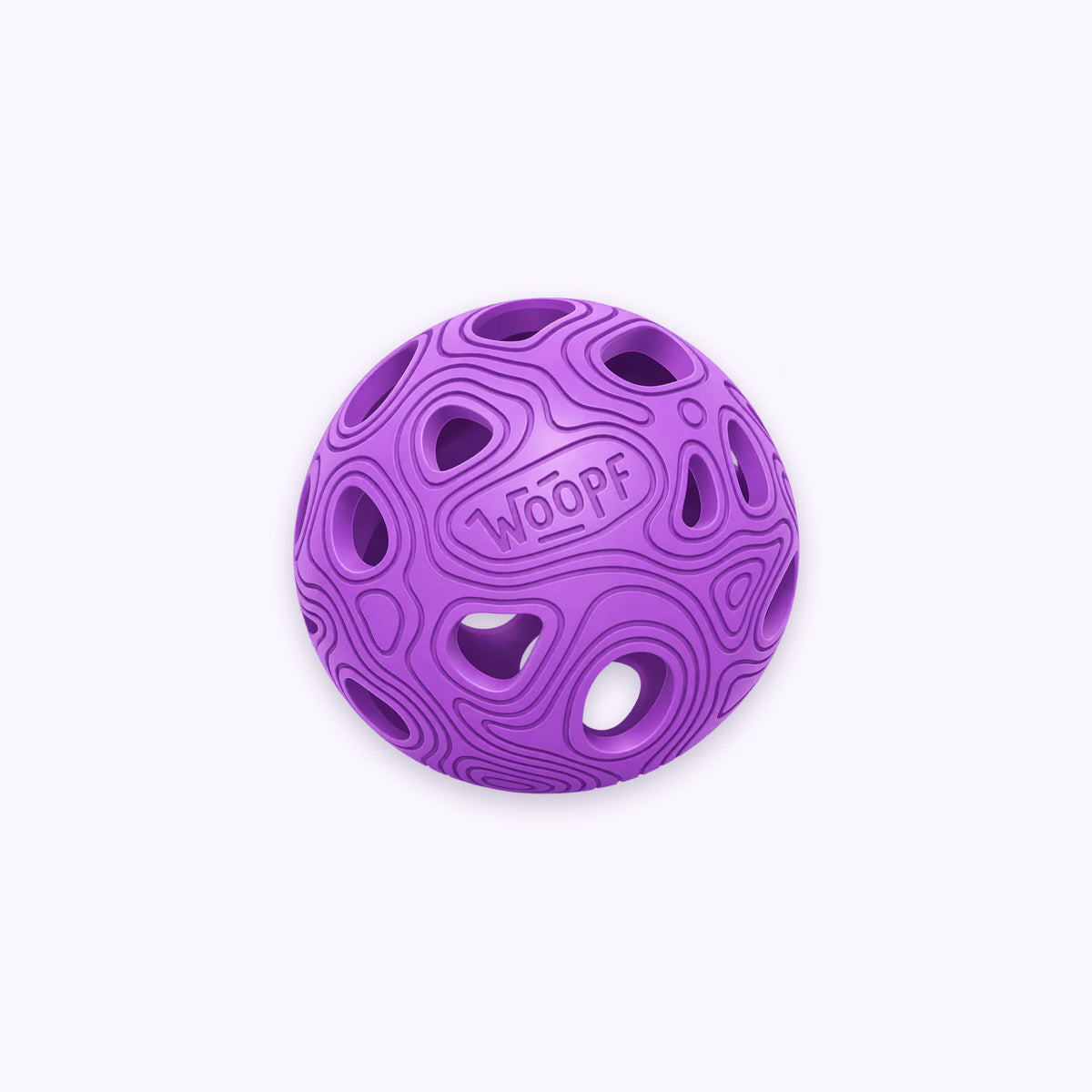
- MeteorBite Ball 2 PackShop
For high-energy dogs. High-bounce fetch keeps them active longer