

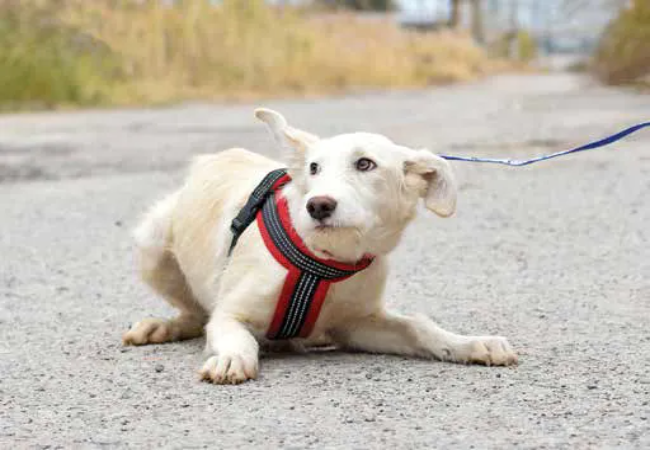


You pick up the harness and your dog turns into a garden statue. Clip it on, and four paws plant themselves like the floorboards are made of glue. Meanwhile you're standing at the door with the keys, wondering what on earth you did.
Probably nothing. A dog that freezes in a harness isn't being stubborn or naughty. Freezing is how a lot of dogs say "I'm not sure about this", and once you work out what "this" is, most dogs come good with some patience and a better routine.
Quick answer
Dogs usually freeze in a harness because something about it worries or bothers them: new straps, a fit that pinches or rubs, a bad past experience, or what the harness usually leads to. Check the fit, then rebuild the routine in small, rewarded steps. If your dog also limps, yelps or seems stiff, see your vet.
Is freezing a big deal?
It's worth taking seriously, mostly because freezing is communication. Sudden stillness or freezing is one of the subtle signs that a dog is stressed or worried.
A freeze is also a low-level warning in dog body language. If a frozen, worried dog keeps getting pushed, some escalate to growling, snapping or even biting, so a freeze is your cue to back off, not to push on.
And sometimes it's pain talking. Behavior researchers list refusing to go for a walk and freezing on a walk among the problems that can be driven by pain, which is why a dog that suddenly starts freezing deserves a closer look.
Why dogs freeze in a harness
1. It feels strange
New straps, new pressure around the chest, the click of buckles near their ears. Some dogs back away or freeze simply because the harness feels unfamiliar, and puppies and dogs new to harnesses often need time to get used to the feel.
2. The fit is off
A harness that pinches behind the elbows, rides up toward the throat or presses on a sore spot makes walking unpleasant, and some dogs respond by not walking at all. A quick test: if your dog walks differently with the harness on than without it, it isn't comfortable yet.
3. The harness predicts what comes next
Some dogs aren't worried about the gear itself, but about what usually comes next, like going outside or getting in the car. If the harness mostly comes out before the vet, the groomer or a long car trip, it can start to mean "uh oh". A tell-tale clue: your dog is happy in the harness in the lounge room but freezes at the front door, or only changes once they're geared up.
4. The world outside is a lot
Traffic, a barking dog behind a fence, a scary bin on the footpath. Some dogs freeze on the lead because the environment is overwhelming, and the harness just happens to be on when it happens.
5. Something hurts
Sore joints, a sore back or neck, or rubbed skin under a strap can all make moving in a harness unpleasant. A dog can't tell you it hurts, so stopping still may be the clearest message they can send.
Working out which of these is behind your dog's freeze can take some detective work, and your vet or a reward-based trainer can help you narrow it down. Here's vet Dr Duncan Houston's take.
Dr Duncan's advice: It can be that the dog knows it's time for a walk, but it can also be scary to have something put over their neck. It takes time, and you need to make putting the harness on fun. Some dogs hate it and always avoid it.
When freezing could be pain: signs that need a vet
Book a vet visit if the freezing comes with any of these:
- limping, stiffness, or trouble with stairs, jumping into the car or getting up
- a yelp, flinch or skin twitch when you touch the neck, shoulders, back or the spots where straps sit
- stopping or freezing mid-walk even without the harness on
- starting to avoid the harness altogether, or a sudden change in a dog that used to love walks
- red, broken or sore skin under the straps
It's also worth a check if the freeze seems out of proportion to whatever set it off, because pain can make a dog's reaction much stronger than the trigger deserves.
If you're not sure whether it's pain or worry, it's always reasonable to book a check. Ruling pain out first means you're training the right problem.
Dr Duncan's advice: Check the harness first. It should slide over the head easily, you should be able to fit two fingers between the harness and the skin, and the straps shouldn't pull under the armpits or on the neck. If your dog keeps freezing and doesn't like the harness at all, it's best to chat with your vet about working out why, whether it's behavioral or pain related.
How to help a dog that freezes in the harness
Step 1: Check the fit
- You can slide two fingers flat under every strap.
- The front of the harness sits on the breastbone, not across the throat.
- An over-the-head harness slides over the head easily.
- Nothing digs into the armpits or pulls on the neck when your dog stands, sits or turns.
- Your dog walks the same way with the harness on as with it off.
- The skin under the straps looks and feels normal.
If the harness fails any of these, adjust it or try a different one before you start any training.
Step 2: Take the pressure off
Don't drag or haul a frozen dog forward on a tight lead. Let the lead go slack, give them a moment, and wait for any small sign of movement. Then reward it.
Step 3: Restart the harness from scratch
Keep sessions short and upbeat, and go at your dog's pace.
- Put the harness on the floor with a few treats scattered around it, and let your dog investigate.
- Hold the harness up and feed treats through the head hole, so your dog chooses to push their nose through.
- Click the buckles while you hold the harness, then treat, so the noise predicts something good.
- Slip it over the head without doing it up, treat, and take it off again.
- Do it up, treat, and undo it. Slowly build up how long it stays on.
- If your dog backs away at any step, take the harness off and go back a step.
Step 4: Get moving indoors first
Once the harness is on, get your dog moving with a game, a few easy tricks or a trail of treats across the room. Reward even tiny steps forward. Only head outside when walking around the house in the harness is no big deal.
Step 5: Make the harness mean good things
Put the harness on for the fun stuff too: a sniffy walk, the park, a visit to a favorite person. If it only ever comes out for the vet, expect it to stay a bit suspicious.
Step 6: Try a different style
Over-the-head, step-in and clip-around harnesses all feel different. Switching style can help if your dog has bad memories of an old harness. If going over the head is the scary part, a harness that clips around the neck and body may suit a head-shy dog better, and the same clip-around style can suit dogs that don't like having their legs lifted.
Common mistakes
- Dragging or carrying them forward every time. It gets you out the door today and makes the harness scarier tomorrow.
- Tightening the harness to stop the wriggling. A tighter harness is usually a less comfortable one.
- Only using the harness for vet, groomer and car trips.
- Sessions that go on too long. Stop while your dog is still relaxed.
- Leaving it on all day to "get them used to it". It doesn't build confidence, and it brings problems of its own. See can a dog wear a harness all day?
- Writing it off as stubbornness. That skips both the fit check and the pain check.
Preventing harness freezes
- Introduce any new gear slowly, even if your dog was fine with the last harness.
- Recheck the fit as puppies grow and as adult dogs gain or lose weight.
- Keep good treats on you for the first weeks of walks in a new harness.
- Learn your dog's quiet signals. Turning away, lip licking, yawning, ears back and sudden stillness are all early signs your dog is worried.
Gear that can help
No harness will fix a worried dog on its own, but comfortable gear and treats within reach make the training a lot easier.
- Explorer Harness: four adjustment points at the neck and chest and elastic chest loops that give as your dog breathes, so you can fine-tune the fit for an awkward shape.
- Explorer Dual Pocket Pouch: a zipped back pocket with room for keys and training treats, plus poop bags up front. Clip it to the human side of the walk. On a dog's harness, as the product page says, "it bounces against the ribs and the treats are theirs to steal."
Frequently asked questions
Why does my dog freeze on the lead outside when the harness is fine?
Often it's the environment: a noise, another dog, a smell or traffic. Give your dog some space and time, notice what they're looking at, and try walking away from it in a different direction. If it's new, or it comes with stiffness or limping, get your vet to check for pain.
My dog freezes when I put a coat or jumper on too. Is that the same thing?
Usually, yes. Something new is touching their body, and some dogs need to get used to the feeling. The same slow, rewarded steps work for coats as for harnesses.
How long will it take my dog to stop freezing?
There's no set timeline. Some dogs accept new gear in a few sessions; others need much longer or a personal plan. If progress stalls, a reward-based trainer or behaviorist can help.
Should I pick my dog up and carry them?
For a small dog stuck somewhere genuinely scary, a quick lift can be kinder than dragging. But carrying them past every freeze skips the learning, so keep working on the steps above at home.
Keep going
If your dog runs off as soon as the harness comes out, our guide to a dog that hates their harness has more ideas, and our harness fitting guide walks through the fit step by step.
For the medical side, ASK A VET™ goes deeper in How to Tell If Your Dog Is in Pain and, for young dogs, Why Won't My Puppy Walk on the Lead?
More dog health reading lives at ASK A VET™.
Recommended by Dr Duncan
Vet-designed gear for what you have just read about.
- Explorer HarnessShop
No-pull training harness with adjustable fit
- Poop & Go 100% Compostable BagsShop
100% compostable & plant-based
- Explorer Bungee LeashShop
Run together. Designed for pullers & high-energy dogs